
Who Influenced Your Work?
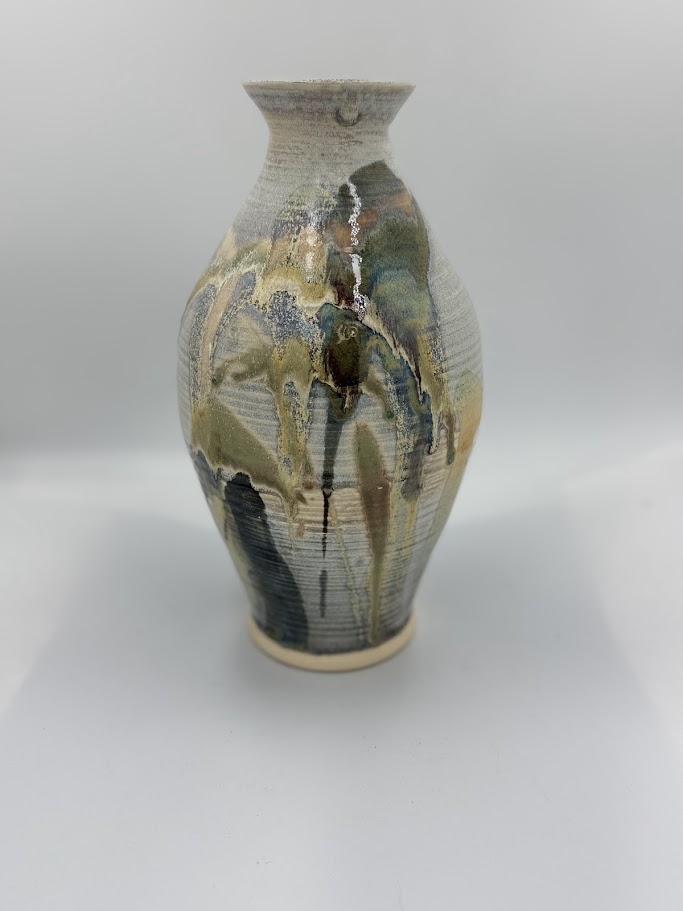
Lori was introduced to wheel throwing by my high school art teacher, also my uncle. I made a couple items but was not as interested at that time in ceramics. Throughout my high school years, I continued to try many different things in art class such as print making, jewelry making (casting or sheet metal and soldering), painting, drawing….
At Coe College, fall of 1977, as a freshman, Lori enrolled in many art classes and became enamored with ceramics.
I’m sure if my instructor had been anyone other than Art Morrison, I wouldn’t have the skills that I have today. He was a stickler for form and precision pottery. (I own one piece of his, a spice jar that is exquisite in form and function).
I recall an assignment to make ten or more cylinders of the same size and shape, early on in ceramics class. He cut in half most of the class’ production with a wire to show how even or uneven our sides were. I recall being shocked at the time, but we all became proficient potters! I also recall his folkart, Farmonia works, as he worked on them in the same studio space. They were a wonderment. 3D constructions as well as huge wall pieces made in sections. He was a well known professional artist. In fact all of the instructors in the art department were producing art and nationally known. My advisor, Robert Kocher, was active in fiber art….I’ve got that “bug” too and that’s another story. But back to the pottery studio….. We had a great time making our own glazes, using a huge outdoor gas kiln, and a raku kiln as well. The pottery class was famously known for some outrageousness, to include our black slip parties.
Art Morrison
Jens (Art) Morrison, born April 28, 1939 and raised in Southern California, is an artist who began making ceramics in the California Funk tradition. Funk artists are sensitive to materials and processes, often using plaster molds for slip casting, sometimes employing crude hand-building, underglazes, lusters, brightly colored low-fire glazes, and house paint. They are inventive, explorative, and at the Funk movement's inception, with an edgy sense of subject matter often seeking to irritate or shock to make a point.
Morrison first came to national attention when on the art faculty at Coe College in Iowa, where he adopted a new first name of "Art," and invented an imaginary society called Farmonia, populated by anthropomorphized pigs and their architecture all made of low-fire clay. Morrison was deeply involved in anthropology, and this was reflected in his work. With Farmonia he was able to illuminate and poke fun at the rural society around him.
Having moved from Iowa years ago, his current home is located near the border of Mexico and several times a year he visits the Mexican countryside, fascinated by its folk art.
Through his works today, Morrison has evolved to conveying his respect for Mexican architectural forms.
His small houses, each named for a village, resemble reliquaries filled and surrounded by small objects--hearts, shells, cacti, crescents, trees and roses--all sitting on trays. Everything, however, with the exception of nails and thorns, is made of low-fire clay under a palette of pastel glazes and lusters. Over the years, Morrison has simplified the procedures for his hand-built structures.